

Operating a healthcare practice and staying financially stable in today’s healthcare environment is not as easy as filing insurance claims. It’s vital that all payments received are properly documented and accounted for. It is here that payment posting in medical billing can be of great importance.
One of the most critical processes in Revenue Cycle Management (RCM) is payment posting, which enables healthcare organizations to monitor their insurance claims, patient payments, adjustments, denials, and outstanding amounts. Payment posting, done right, gives a good overview of financial performance and recognizes problems early enough to avoid affecting revenue.
But improper payment posting can result in claim delays, billing mistakes, patient dissatisfaction, poor cash flow, and revenue leakage. Operational inefficiency and reimbursement rates could be impacted by even minor posting errors over time.
The need for proper payment posting is growing more critical as healthcare organizations strive for revenue cycle optimization under pressure to be financially transparent, improve collections, and remain compliant.
Medical billing payment posting refers to the recording of insurance and patient payments, denials, and adjustments in the billing system to ensure that accurate financial records are kept and to enhance revenue cycle management.
What Is Payment Posting in Medical Billing?
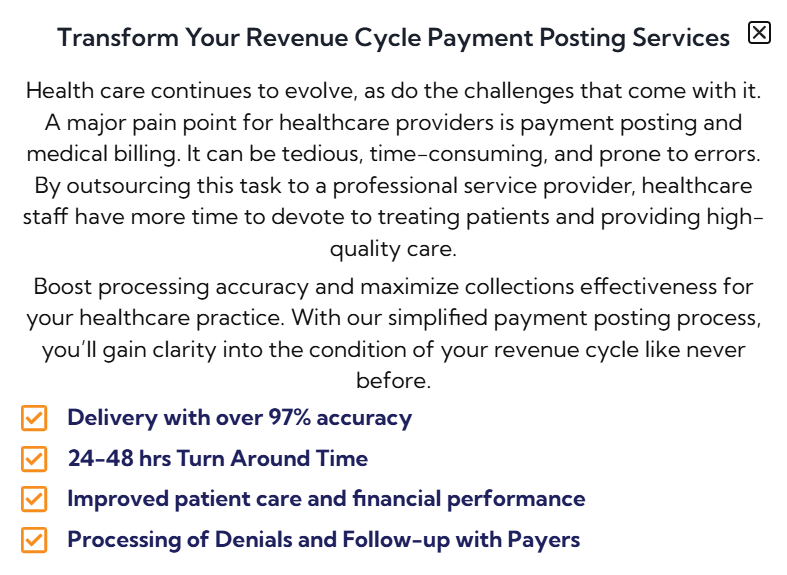
Payment posting in medical billing involves the action of capturing and processing payments from the insurance companies and the patient into a healthcare provider’s billing system. It guarantees accurate recording of all financial transactions in patient accounts and in the revenue cycle reports.
Documenting involves documenting:
- Insurance payments
- Patient payments
- Co-pays
- Deductibles
- Adjustments
- Denials
- Write-offs
- Outstanding balances
The process of payment posting is a crucial step between claim reimbursement and financial reconciliation, enabling providers to keep track of payments and spot discrepancies.
Payment posting eliminates the risk of having any missed payments from insurance companies or patients not properly posted in the provider’s billing system.
Why Payment Posting Is Important in Revenue Cycle Management
Improves Financial Accuracy
To ensure proper posting of payments, the accuracy of these postings should be verified. This reduces the risk of accounting mistakes and helps to ensure accurate financial reporting.
Reduces Revenue Leakage
Payment posting aids in the detection of underpayments, missing payments, and improper reimbursements while they are still in the payment process, rather than when they affect revenue.
Enhances Cash Flow
Accelerated posting helps smooth out the cash flow and improves collections for healthcare providers, thanks to timely posting.
Helps Identify Claim Denials
Denied claims are easily identified through proper payment posting, allowing billing staff to look into the problem and take corrective action.
Improves Patient Billing Transparency
Valid account updates decrease billing disagreements and make it clear to patients what their responsibilities are and what is owed.
Read more blog : RCM Services for Small Clinics vs Large Hospitals Key Differences
How the Payment Posting Process Works
Receiving Payments
There are several avenues for healthcare providers to receive payments, which include:
- An Electronic Remittance Advice (ERA) is a report detailing the payment that has been received
- Explanation of Benefits (EOB)
- Patient payments
- Credit card payments
- Online payment portals
Reviewing Remittance Information
Billing teams ensure payment information is accurate by checking remittance documents and comparing claims to payments.
The following are key verification activities:
- Checking claim numbers
- Confirming reimbursement amounts
- Reviewing adjustment codes
- Identifying denied claims
Posting Payments into Billing Software
Payments are recorded in the billing system and allocated to patient bills.
This includes:
- Recording payment amounts
- Updating account balances
- Applying co-pays
- Applying deductibles
- Monitoring the remaining responsibility of the patient
Recording Adjustments and Write-Offs
Contractual adjustments and allowed amounts are posted as per the agreements with the payers.
Examples include:
- Insurance contractual adjustments
- Provider write-offs
- Non-covered service adjustments
Handling Claim Denials
Denial codes are used to identify denied claims and classify them.
The billing staff is authorized to:
- Investigate denial reasons
- Correct claim errors
- Submit appeals
- Resubmit claims
Final Reconciliation
The final step is to reconcile all transactions and make sure that account balances are correct, meaning that they have been paid or are owed correctly.
Payment Posting Workflow
Claim Submission -> Payment Received -> Payment Posting -> Denial Handling -> Account Reconciliation
Types of Payment Posting in Medical Billing
Manual Payment Posting
Manual posting is the process whereby billing professionals manually key in payment details when they have reviewed EOBs and remittance documents.
Electronic Payment Posting
Electronic payment posting is a capability that is used to post payments, payment adjustments, and denials into billing software automatically using ERA files.
Patient Payment Posting
This process is about recording:
- Self-pay collections
- Co-pay payments
- Deductibles
- Outstanding patient balances
Insurance Payment Posting
Records insurance payments from commercial insurance, government programs, and managed care organizations.
Key Components of Payment Posting
Payment posting is comprised of many critical activities:
- Review Electronic Remittance Advice (ERA) and Explanation of Benefits (EOB) documents for payment information, adjustments, denials, and patient responsibility for accurate posting.
- Claim matching – Ensuring payments are matched to claims for accurate reimbursement and discrepancies are identified and addressed promptly.
- Payment Reconciliation – Reviewing payments with remittance and bank deposits to ensure accuracy, detect discrepancies, and ensure proper financial records are kept.
- Adjustment posting – Making contractual adjustments, write-offs, and reductions as per insurance agreements to ensure accurate account balances and reporting.
- Denial management – Determining denied claims, understanding the cause of denial, assigning correct codes, initiating corrective actions, including appeals, claim resubmissions, etc.
- Helping to ensure accurate balances and communicate financial responsibilities after payments and adjustments are made to patient accounts.
- Underpayment identification – Identifying where insurers are paying less than the amounts agreed to, and allowing billing staff to dig up missed revenue.
- Reporting and auditing – Creating financial reports and conducting audits to track the accuracy of payment posting, compliance, revenue trend, and overall revenue cycle performance.
They all help to ensure accurate financial management and optimum revenue.
Common Challenges in Payment Posting
Incorrect Data Entry
Manual entry mistakes can lead to incorrect balances and reconciliation problems.
Missing Payments
If the missing reimbursement items are not identified, the consequences can be revenue loss and delayed collections.
Insurance Underpayments
Payers may occasionally pay less than the contracted amount; careful review and follow-up are required.
Delayed Posting
Late payment posting has an impact on cash flow visibility and financial reporting accuracy.
Denial Tracking Issues
The inefficiency in denial management can lead to higher A/R and lower reimbursement rates.
Reconciliation Errors
There can be unmatched differences in accounts due to incomplete reconciliation processes.
These are mitigated and increased posting accuracy and efficiency using automation tools and skilled medical billers.
Benefits of Accurate Payment Posting
- Timely payment posting – Speeds the payment posting process and minimizes the delay in collections.
- Improved Cash Flow – Accurate payment recording ensures steady revenue flow and better financial stability.
- Minimized Billing Errors – Correct posting decreases errors when it comes to patient accounts, payments, and adjustments.
- Improved Claim Management – Provides efficient tracking of claim status, payments, denied claims, and balances.
- Correct Patient Balances – Patient is billed properly and is responsible for paying the bill.
- Shorter Claim Denial Turnaround – Finds issues early, allowing for faster issues to be corrected and claim denials to be avoided.
- Better Financial Reporting – Helps to report, forecast, and make decisions based on reliable financial information.
- Improved Compliance Management – Assists in compliance with payer guidelines, regulations, and documentation requirements.
- Better Operational Efficiency – Optimizes workflows, minimizes manual tasks, and enhances worker productivity.
- Better Revenue Cycle Performance – Improves reimbursement rates, minimizes revenue leakage, and streamlines collections.
Right payment posting can help healthcare organizations claim reimbursements and ensure financial visibility throughout the revenue cycle.
Payment Posting vs Medical Billing
Medical billing involves preparing and submitting medical claims, while medical payment posting involves ensuring that all payments and adjustments are correctly entered and balanced.
Role of Payment Posting in Denial Management
Payment posting is a key element in denials management and assists healthcare providers:
- Be able to recognize denied claims in a timely fashion
- Analyze denial trends
- Reduce future denials
- Improve reimbursement rates
- Communicate with the Department of Motor Vehicles and speed up appeals and resubmissions.
However, the lessons learned from denied claims help to decrease the number of claim denials in the future. This can help organizations see patterns and make necessary changes that enhance claim acceptances and overall revenue.
How Automation Improves Payment Posting Efficiency
ERA Automation
Automatic posting of the payment and adjustments with electronic remittance processing also saves manpower.
AI-Based Reconciliation
AI is able to uncover discrepancies, underpayments, and unmatched claims more effectively.
Real-Time Reporting
Automated systems offer real-time insights on collections, denials, and reimbursement.
Reduced Human Errors
Manual data entry errors are reduced, and posting accuracy is enhanced by automation.
Faster Processing
Automated workflows significantly reduce processing times, enabling quicker account updates and financial reporting.
Best Practices for Effective Payment Posting
- Conduct daily payment reconciling
- Check all ERAs and EOBs
- Track denials immediately
- Monitor insurance underpayments
- Ensure proper patient documentation
- Make use of automated billing software.
- Conduct regular audits
- Re-read payer contracts from time to time.
- Have uniform posting policies
These practices contribute to accurate financial positioning and maximize revenue cycles.
Industries and Healthcare Providers That Benefit from Payment Posting Services
Accurate payment posting can be beneficial to various healthcare organizations, including:
- Hospitals
- Clinics
- Dental practices
- Behavioral health centers
- Physician groups
- Ambulatory surgery centers
Improved reimbursement tracking, fewer denials, and greater financial visibility are all good things for organizations of all sizes.
How Nirvaana CS Supports Accurate Payment Posting Services
Correct payment posting is vital for a successful revenue cycle, and at Nirvaana CS, we know that. Our highly trained Revenue Cycle Management team can offer you complete payment posting solutions that help you optimize reimbursements and boost financial accuracy.
Here are some of our payment posting solutions:
- Quick and precise payment posting
- Reconciliation: insurance and patient payments
- Denial tracking and management
- Revenue optimization support
- HIPAA-compliant processes
- Automated workflow integration
- Prevents underpayment; identifies and addresses
- Detailed financial reporting
Nirvaana CS enables healthcare organizations to optimize payment posting and boost their revenue cycle performance, all while minimizing administrative tasks and enhancing overall efficiency.
Frequently Asked Questions (FAQ)
- What is payment posting in medical billing?
Payment posting is the process of making the insurance/payment, adjustment, denial, and write-offs entries in a health care provider’s billing system.
- Why is payment posting important?
It provides accurate financial information, helps with cash flow, helps to detect denials, prevents revenue leakage, and enables good revenue cycle management.
- What is the difference between ERA and EOB?
ERA (Electronic Remittance Advice) is an electronic remittance file for automated payment posting, and EOB (Explanation of Benefits) is an explanation of claim payment and patient responsibilities.
- How does payment posting improve cash flow?
Properly and correctly posting payments will speed up the reconciliation process, uncover outstanding payments, and enable timely revenue collection for providers.
- What are common payment posting errors?
Typical mistakes are data entry, missing payments, mismatching payments and recon errors, underpayment oversight, and denial tracking.
- Can payment posting reduce claim denials?
Yes. Corrective actions, appeals, and claim resubmissions can be faster and more accurate with the help of accurate payment posting, which can also help identify denial patterns.
- Is payment posting automated?
Automated ERA posting and AI-powered reconciliation tools are utilized by a lot of healthcare organizations for improved accuracy, proficient handling, and quicker processing.
Conclusion
Payment posting is an important aspect of medical billing and Revenue Cycle Management. Healthcare providers will have improved financial visibility and control over their revenue cycle with accurate insurance reimbursement, patient payment, adjustment, and denial records.
By enhancing cash flow, lowering claim denials, cutting billing mistakes, ensuring compliance, and boosting financial results, effective payment posting delivers significant benefits for every aspect of a healthcare organization’s finances. Payment posting works well in conjunction with effective denial management initiatives and cutting-edge automation tools to maximize revenue.
Payment posting accuracy allows health care providers to reap a host of benefits, such as better cash flow, fewer claim denials, and healthier financial health, which enables efficient revenue cycle management. By leveraging the expertise of RCM professionals such as Nirvaana CS, healthcare providers can optimize their revenue cycle, boost accuracy, enhance efficiency, and secure long-term financial success.