
nirvaanacs.com

Categories
Business Process Outsourcing

Why Businesses Choose Outsourcing Service Providers in the USA

Outsourcing, which is also otherwise known as Business Process Outsourcing  (BPO), has developed into not only a cost-cutting strategy but also a growth tool among contemporary businesses. Firms in all sectors are no longer outsourcing with the aim of saving money, but they are outsourcing with the aim of getting access to better talent, better customer experience and ensuring that they run smoothly.

The trends in global outsourcing have been observed to change in the recent past. Although offshore destinations are still favoured due to the cost factor, most businesses are moving towards US-based outsourcing service providers, particularly those that are aimed at the premium markets. It is because of one simple reason – quality, compliance, and trust.

The outsourcing providers in the US include a blend of highly qualified personnel, excellent regulatory policies and a business culture that is founded on accountability. In the case of sensitive data, high-value customers, or complex operations, these considerations are not optional at all but necessary to companies that are involved in such activities.

Why Businesses Choose Outsourcing Service Providers in the USA

Outsourcing service providers are companies that are third parties, and they perform certain business operations on behalf of another organisation. Businesses collaborate with these providers to outsource the activities of the in-house team to facilitate the execution of each operation more effectively.

Such services normally involve:

  • Customer care (phone, e-mail, chat)
  • Technical support and IT services
  • Back-office (data entry, billing, payroll)
  • Accounting and finance services
  • HR and the recruitment procedures

In the contemporary dynamic business world, outsourcing partners are very important in ensuring that organisations are able to concentrate on their core areas. Instead of dealing with the operational complexities at hand within the business, the business can serve the purposes of outsourcing such operations to the specialists who are better placed to deal with the same.

Key Reasons Businesses Prefer US-Based Outsourcing Providers

Access to Skilled English-Speaking Workforce

Availability of highly skilled and native English-speaking labour is one of the greatest benefits of the US outsourcing providers. Communication is not only concerned with language, but it is also about clarity, tone of voice and cultural knowledge.

The teams of the US are well-known in:

  • Dealing with multidimensional customer relationships
  • Knowing the locals and their anticipations
  • Providing effective and regular communication

In the case of businesses that target North American customers, it will mean that they will facilitate a more enjoyable and efficient customer experience.

Strong Data Protection & Compliance Standards 

Modern business, in particular, healthcare, finance, and SaaS, is concerned with data security. The US outsourcing companies are subject to stringent regulatory systems, which include:

  • HIPAA (of healthcare data)
  • GDPR (to comply with data protection requirements worldwide)
  • Other security standards, such as SOC 2.

These laws provide security and responsibility in the handling of sensitive information. When companies outsource to the US providers, it is possible to mitigate the risk of data breach or compliance breach significantly.

Transparent Communication & Work Culture

US outsourcing firms have been characterised by the well organized workflow and open communication. This includes:

  • Clear reporting mechanisms
  • Stipulated service-level agreements (SLAs).
  • Regular performance tracking

The organisational culture is accountable and professional. The businesses have a clear understanding of what to expect, and there is not much ambiguity regarding deliverables or timelines.

High-Quality Service & Brand Trust

US outsourcing providers are really good at quality. Their services tend to be aligned towards the premium standards, and this will assist the businesses to have a good brand image.

Key advantages include:

  • Consistent service quality
  • Well-trained professionals
  • Close attention to customer satisfaction.

Outsourcing to the US providers will strengthen the trust and credibility of the market among companies that want to build or sustain a premium brand.

Key Benefits of US-Based Outsourcing Services

The selection of a BPO services  US outsourcing partner has several realistic advantages:

  • Better Customer Satisfaction (CSAT) – Enhanced communication and quicker issue resolution lead to an immediate increase in customer satisfaction scores.
  • Faster Response Times – By having teams that are aligned with the US time zones, the business is in a position to provide real-time support without delays.
  • Scalable Operations – US providers are also flexible in scaling and enable businesses to scale up or down when necessary.
  • Reliable Service Quality – Homogenised processes and strict quality measures are used to achieve the same performance in all of the operations.

US Outsourcing vs Offshore Outsourcing

AspectUS Outsourcing ProvidersOffshore Providers
CommunicationNative English fluencyMay vary
Data SecurityHigh compliance standardsModerate to high
CostHigherLower
QualityPremiumVaries
Time ZoneSuitable for the US marketMay differ

Although offshore outsourcing is relatively cheaper, US outsourcing is superior in the areas that have a direct influence on customer experience and regulatory adherence.

When Should You Choose US Outsourcing Providers?

The outsourcing to the US is not mandatory at all. However, in some cases, it is the wiser decision.

You need to look at US providers when:

  • You deal with high-value customer deals
  • Your company handles sensitive/regulated information
  • The United States is your major market
  • What you are selling is a high-end brand

Under such situations, the positive aspects of quality, trust, and compliance are more than the increased expenses.

Challenges of US Outsourcing (And Solutions)

Higher Costs

Cost is one of the most dominating issues with US outsourcing. The US services are costlier compared to offshore services.

Solution – Implement a hybrid model of outsourcing. Support customers and other activities that demand high compliance should be outsourced to US providers, whereas the routine operations should be outsourced to offshore teams.

Limited Scalability Compared to Offshore

Offshore vendors are usually able to access bigger talent pools and scale faster.

Solution – Integrate the US and offshore teams. Quality control and customer-facing functions should be done by US teams, whereas offshore teams should be used in tasks that are volume-based.

Industries That Benefit Most from US Outsourcing

The US-based outsourcing is more valuable to certain industries because of their special needs:

  • Healthcare – The US providers are a better option to deal with patient data due to the strict compliance standards, such as HIPAA.
  • The banking, financial services, and insurance industry (BFSI) – Outsourcing to the US is very appropriate since it is mainly about security, trust, and regulatory compliance.
  • E-commerce – High customer service is needed to retain and maintain customer loyalty.
  • SaaS & Tech Companies – Customer success and technical support involve effective communication and problem-solving skills, which are at their best in US teams.

Future Trends in US Outsourcing Services

The landscape of outsourcing is developing at a very fast rate, and the US providers are at the leading edge of change.

  • AI-Powered Customer Support – AI are being incorporated in order to enhance efficiency without losing human control.
  • Omnichannel Communication – Enterprises are not just going beyond voice support to incorporate chat, email, social media and so on.
  • Hyper-Personalisation – Interactions with customers are becoming more personal, and it requires experienced agents and the use of data.
  • Remote Workforce Expansion – Remote work has increased the talent pool in the US, and thus, outsourcing has become more adaptable and reachable.

Conclusion

The services provided by outsourcing providers in the USA are a good combination of quality, compliance and trust. They might be more expensive, but they cannot be compared to the value they provide, particularly in security and customer experience.

In the case of companies in the high-end markets, dealing with sensitive information or focusing on brand image, US outsourcing is not only an opportunity, but a competitive benefit.

When selecting the appropriate outsourcing partner, it actually depends on what you want in business. However, when quality, reliability, and compliance are on the first list, US-based providers are worth the money.

FAQs

What are outsourcing service providers?

Outsourcing service providers refer to the companies which deal with certain business processes such as customer care, IT services, and back office work of other businesses.

Why do companies choose US outsourcing providers?

US providers are favoured by companies because of quality services, good compliance standards, and good communication skills.

Are US outsourcing services expensive?

Yes, it is true that they tend to be more costly than offshore, but they are of higher quality and more secure.

Which industries benefit most from US outsourcing?

The compliance and customer experience requirements are most beneficial to the healthcare, BFSI, SaaS, and e-commerce industries.

Is US outsourcing better than offshore outsourcing?

It is dependent on the business requirements. US outsourcing is superior in terms of quality and compliance, whereas offshore is less expensive.

Categories
BPO

Which Industries Benefit the Most from BPO Service Providers?

BPO service providers help businesses manage non-core functions such as customer support, IT services, finance, and back-office operations. While many industries use outsourcing, sectors like healthcare, banking and finance, e-commerce, and telecommunications benefit the most from BPO services because of their high operational workload and customer service requirements.

By partnering with reliable BPO service providers, companies can reduce operational costs, access global talent, improve efficiency, and focus on core business growth. In today’s business environment, outsourcing is a growth strategy that helps companies scale faster and operate more efficiently.

Which Industries Benefit the Most from BPO Service Providers?

Business Process Outsourcing has evolved significantly over the years. Earlier, companies mainly used outsourcing to reduce costs. However, today outsourcing has become a strategic partnership that helps companies improve efficiency and service quality.

Many companies face a common challenge. Hiring employees, training teams, managing operations, and maintaining infrastructure takes time and resources. As businesses grow, operational workload increases, which can slow down growth.

This is where BPO service providers  play an important role. They help businesses manage non-core operations such as customer support, back-office operations, IT services, finance, and administrative tasks. Companies like Nirvaana CS help businesses streamline operations so they can focus on their core business and long-term growth.

What are BPO Service Providers and Why Do They Matter?

Business Process Outsourcing (BPO) refers to outsourcing business operations or specific tasks to a third-party service provider. These tasks are usually operational or administrative tasks that are necessary for business operations but are not part of the company’s core business function.

Earlier, BPO services were mostly limited to call centers and customer support. However, over time, outsourcing has expanded into finance, HR, IT services, healthcare billing, digital marketing, and legal support. This evolution has also led to Knowledge Process Outsourcing (KPO), where specialized and knowledge-based services are outsourced.

BPO service providers matter because they help businesses reduce operational workload, improve efficiency, access skilled professionals, and scale operations quickly. Instead of building large internal teams, companies can outsource processes and focus on core business growth and strategy.

Top Industries Reaping the Rewards of Outsourcing

Different industries use BPO services  in different ways. However, some industries benefit more because they have high operational workload and customer support requirements.

Below are the top industries that benefit the most from BPO service providers.

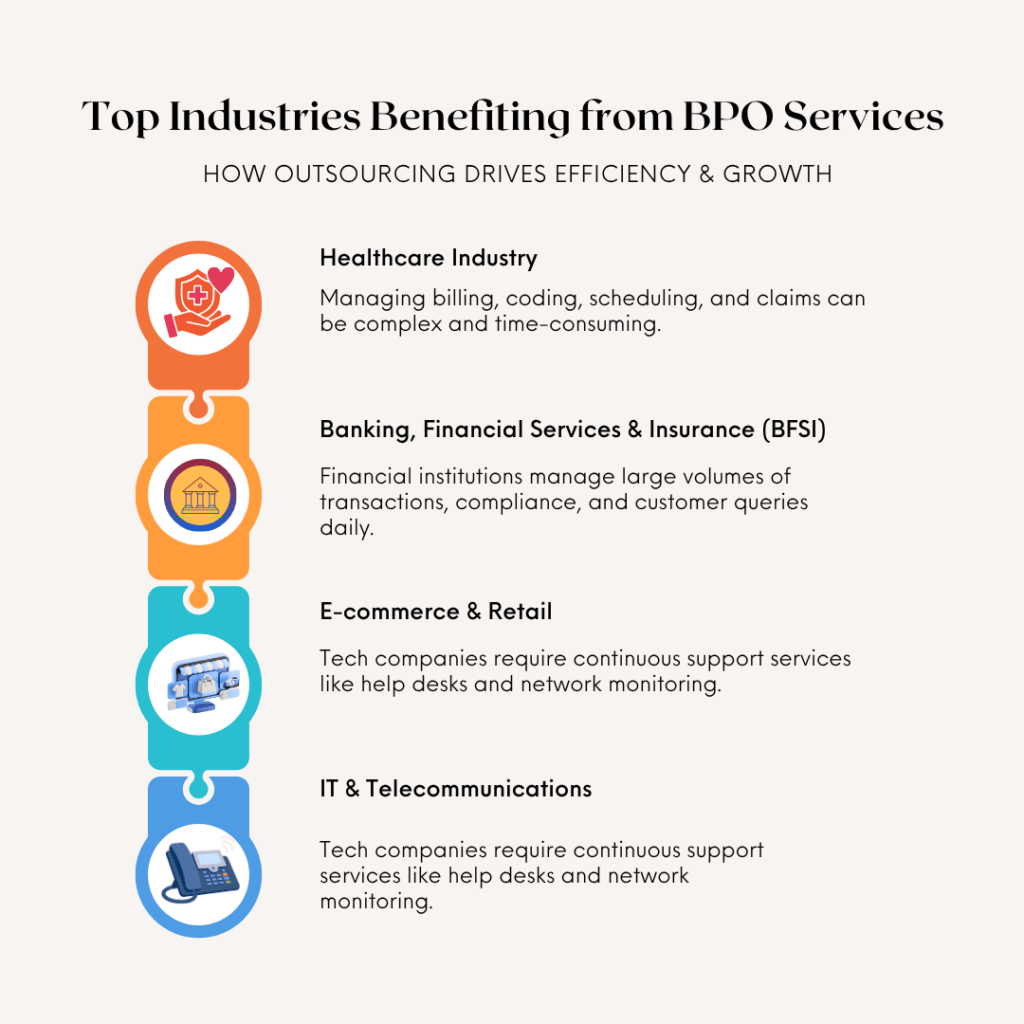
1. Healthcare: A Surge in Medical BPO Services

The healthcare industry generates a large amount of administrative work, including medical billing, coding, patient scheduling, insurance verification, and claims processing. Managing these processes internally can be expensive and time-consuming.

BPO services for healthcare  providers help manage medical coding, billing, claims processing, patient support services, and revenue cycle management. A medical BPO services provider also ensures compliance with healthcare regulations such as HIPAA and reduces administrative workload for healthcare staff.

As a result, doctors and hospitals can focus more on patient care while administrative and billing tasks are managed by outsourcing partners.

2. Banking, Financial Services, and Insurance (BFSI)

The banking and financial services industry handles large volumes of transactions, customer queries, compliance processes, and financial documentation. Managing all these processes internally requires large teams and operational costs.

BPO service providers help BFSI companies manage customer support, loan processing, data entry, fraud detection support, compliance documentation, and accounting services. Outsourcing helps financial institutions improve accuracy, reduce operational costs, and manage high-volume processes more efficiently.

3. E-commerce and Retail

E-commerce and retail businesses require continuous customer support, order tracking, returns management, inventory updates, and payment support. Customer queries can increase significantly during sales seasons and promotional periods.

BPO providers help manage customer service, chat support, email support, order processing, and returns management. This allows e-commerce companies to handle seasonal spikes without hiring permanent staff and manage customer service more efficiently.

4. Information Technology and Telecommunications

IT and telecommunications companies require technical support, help desk services, customer support, and network monitoring services. Managing support teams internally can reduce focus on product development and innovation.

BPO service providers offer technical support teams, help desk services, remote IT assistance, and customer service operations. This allows technology companies to focus more on research, development, and product innovation while outsourcing support operations.

Why Partnering with the Most Reliable BPO Service Providers is Critical

Choosing the right BPO partner is very important because outsourcing involves sharing business processes, operational responsibilities, and sometimes sensitive customer data.

Below are the key reasons why partnering with reliable BPO service providers is important.

Data Security and Privacy Protection

Businesses share customer data and business information with outsourcing partners. Therefore, data security and privacy protection are very important. Reliable BPO providers follow strict data security policies, compliance standards, and secure systems to protect business and customer data.

Scalability and Operational Flexibility

One of the biggest advantages of BPO services is scalability. Businesses can increase or decrease team size based on workload and business requirements. This flexibility helps companies manage growth, seasonal demand, and new projects easily.

Access to Skilled Professionals and Industry Expertise

BPO companies hire trained professionals who specialize in different industries and processes. This allows businesses to access skilled professionals without investing in hiring, training, and infrastructure internally.

Finding a BPO Service Provider Near Me: Does Location Matter?

Many businesses search for a BPO service provider near them because they want better communication, similar time zones, and easier collaboration. This concept is known as nearshoring.

However, offshoring is also common because it offers cost advantages and access to global talent. Today, many companies use a hybrid outsourcing model where some processes are outsourced locally and others offshore.

Location matters depending on business needs. If real-time collaboration and communication are important, a local or regional BPO provider may be a better option. If cost savings and scalability are more important, offshore outsourcing may be more suitable.

Companies like Nirvaana CS position themselves as strategic partners rather than just vendors, offering flexible outsourcing solutions based on business requirements.

The Future: BPO Opportunities as a Service Provider

The BPO industry is evolving rapidly with technology, automation, and remote work models. Outsourcing is no longer limited to customer support and data entry. Instead, companies are now outsourcing high-value and specialized services.

Below are the future trends and opportunities in the BPO industry.

AI and Automation in BPO Operations

Artificial intelligence and automation are transforming BPO operations. Automation is being used for chatbots, workflow automation, data processing, and customer support automation. This improves efficiency, reduces manual work, and increases service speed.

Impact Sourcing and Remote Global Teams

Impact sourcing refers to hiring talent from different regions and remote locations. Remote work has made it easier for BPO companies to build global teams and provide services from different locations. This helps businesses access global talent while reducing operational costs.

Expansion into HR, Legal, and Digital Marketing Services

Modern BPO providers are expanding into new service areas such as HR outsourcing, recruitment support, legal process outsourcing, digital marketing services, and financial consulting. This shows that BPO is moving from task-based outsourcing to full business process management and strategic outsourcing partnerships.

Conclusion

Business Process Outsourcing has become a business growth strategy that helps companies improve efficiency and access skilled professionals.

Industries such as healthcare, finance, retail, IT, and telecommunications benefit significantly from outsourcing because of their operational workload and customer service requirements.

By partnering with Nirvaana CS, businesses can streamline operations, reduce costs, improve productivity, and focus on long-term growth.

Frequently Asked Questions (FAQs)

What are the primary benefits of hiring BPO service providers?

The main benefits include cost savings, access to skilled professionals, scalability, improved efficiency, and the ability to focus on core business activities.

How do I choose the most reliable BPO service providers for my business?

Look for industry experience, data security standards, client reviews, service scalability, transparent pricing, and communication processes before choosing a BPO provider.

What specific medical BPO services do healthcare providers need?

Healthcare providers usually outsource medical billing, coding, claims processing, patient scheduling, insurance verification, and revenue cycle management.

Is it better to find a BPO service provider near me or offshore?

It depends on business needs. Local providers offer better communication and collaboration, while offshore providers offer cost savings and larger teams. Many companies use a hybrid outsourcing model.

What are the emerging BPO opportunities as a service provider today?

Emerging opportunities include AI data processing, cybersecurity monitoring, legal process outsourcing, HR outsourcing, and digital marketing services.

Categories
BPO

Top BPO Service Providers of 2026: A Strategic Guide to High-Growth Outsourcing

By 2026, the role of BPO service providers has changed mainly because the way businesses operate has changed. Nowadays, work is not limited to simple tasks that can be handed off easily as processes now involve constant data movement and strict compliance rules. As a result, outsourcing is no longer only about reducing cost but about keeping operations stable and manageable.

Earlier, BPO models focused heavily on headcount, where success was measured by how many people were deployed on a process. Over time, this approach proved difficult to scale, especially in regulated industries. Now, companies look at outcomes instead. They look at whether work is completed accurately, whether turnaround times are predictable, and whether compliance risks are controlled consistently.

This shift has also changed how BPO providers are evaluated as automation capability, system integration, and digital maturity now matter more than workforce size. At the same time, demand for specialization has increased. Healthcare, finance, and customer experience teams need providers who understand industry-specific workflows and regulations rather than generic outsourcing support.

Essential Capabilities of the Best BPO Service Providers

Below are the essential capabilities of the best BPO Service Providers

Agentic AI and Autonomous Workflows

Many BPO service providers now use agent-based systems to manage workflows that move across multiple platforms. These systems handle tasks such as routing requests, validating data, monitoring transactions, and triggering actions based on predefined rules.

By automating workflow movement rather than isolated tasks, providers reduce delays caused by manual handoffs and system switching. This approach supports higher volumes while maintaining process consistency across teams and locations.

Zero Trust Security and Compliance Shields

Security architecture plays a central role in BPO delivery, particularly for providers working with regulated data. Zero Trust models are widely used, where every system access request is verified, monitored, and logged regardless of user or location.

BPO providers embed compliance controls directly into operations to support requirements such as GDPR, HIPAA, and financial regulatory standards. For many organizations, outsourcing simplifies compliance management because these controls are already operationalized within service workflows.

Multi-Shore Delivery Models

BPO delivery in 2026 commonly spans offshore, nearshore, and onshore locations. Offshore teams handle volume-intensive processes, nearshore teams support time-sensitive collaboration, and onshore teams manage governance and high-risk activities.

This structure allows providers to balance cost efficiency, response time, and regulatory oversight while maintaining continuity during regional disruptions.

Industry-Specific Trends for BPO Service Providers in 2026

While core capabilities remain consistent, how BPO Services   are applied varies significantly by industry due to differences in risk, regulation, and workflow complications.

Healthcare BPO Services: Beyond Medical Billing

Healthcare BPO services now support a broad range of operational processes, including patient onboarding, appointment scheduling, telehealth coordination, documentation management, and administrative follow-ups.

Automation supports data handling and workflow standardization, while security controls protect patient information and ensure compliance with healthcare regulations. These services help healthcare organizations manage growing administrative workloads without expanding internal teams.

BFSI Outsourcing Services: Managing High-Volume Risk

In banking and financial services, BPO providers focus on risk-sensitive operations such as transaction monitoring, fraud detection, and customer verification. BFSI outsourcing services use machine-learning models to analyze transaction patterns and flag irregular activity in real time.

KYC and compliance workflows are automated to handle scale, while review teams manage flagged cases, regulatory interpretation, and reporting requirements.

Next-Gen Call Center Outsourcing Services

Call center outsourcing services now operate across multiple customer interaction channels, including voice, chat, email, and digital messaging platforms. These channels are managed within unified systems that track interactions across the customer journey.

Automation handles structured, high-frequency requests, while agents focus on complex cases that require investigation or resolution across systems.

How to Evaluate and Choose Top Outsourcing Companies

Evaluation of BPO providers usually starts with pricing and scale, but effective selection depends on understanding how a provider operates over time, especially under changing volumes and system dependencies. 

The following areas are commonly reviewed in detail during vendor assessment.

Assessing Technology Infrastructure

Technology infrastructure determines how well a BPO provider can handle integration and process continuity. Most providers in 2026 operate on cloud-based platforms that support automation, reporting, and system interoperability. Evaluation focuses on how workflows are managed across tools, how data moves between systems, and how failures or exceptions are handled.

In addition, buyers assess visibility and control. This includes access to dashboards, audit logs, performance reports, and escalation mechanisms. Providers with mature infrastructure can demonstrate how processes are monitored in real time and how issues are identified and resolved without disrupting delivery.

Analyzing Workforce Quality and Retention

Workforce quality affects process stability and knowledge retention. Evaluation includes reviewing attrition rates, training structures, and role continuity within delivery teams. Providers with stable teams tend to maintain consistent output because process knowledge remains within the organization rather than resetting frequently.

Another factor is role alignment. Buyers assess whether teams are structured around process ownership, quality review, and escalation handling rather than task-based execution alone. This structure supports accountability and reduces dependency on individual contributors.

Balancing Quality with Affordable BPO Services

Cost evaluation involves more than comparing rate cards. Affordable BPO services are reviewed in relation to automation coverage, quality assurance processes, security controls, and governance frameworks. Lower pricing is typically sustainable when efficiency comes from standardized workflows and reduced manual handling.

Risk assessment is part of this evaluation. Buyers examine whether cost savings affect compliance, data security, or service reliability. Providers that document service levels, quality metrics, and escalation paths offer clearer visibility into how affordability is achieved without increasing operational risk.

Conclusion

In 2026, BPO service providers are selected based on their ability to support continuous operations, manage regulatory requirements, and handle scale through stable delivery models and integrated technology. The shift from headcount-driven outsourcing to outcome-focused service delivery has made evaluation criteria more operational and less transactional.

Organizations assess providers on automation capability, security architecture, delivery structure, workforce stability, and industry alignment, particularly in regulated sectors such as healthcare, finance, and customer experience. 

Providers such as Nirvaana Client Solutions operate within this framework by delivering healthcare and financial process outsourcing through standardized and automation-supported, supporting organizations that require predictable performance and operational continuity.

Frequently Asked Questions (FAQ)

Who are the top BPO service providers in 2026?

Global providers such as Accenture and Teleperformance remain prominent, alongside specialized providers focused on automation-led and industry-specific services.

What is the difference between onshore and nearshore BPO companies?

Onshore BPO services operate within the same country as the client, while nearshore services operate from nearby countries with overlapping time zones.

Why do organizations choose healthcare BPO services?

Healthcare BPO services support administrative workload management, compliance requirements, and scalable operations.

Are affordable BPO services safe for sensitive financial data?

Data security depends on governance frameworks, certifications, and monitoring practices implemented by the provider.

How is AI changing call center outsourcing services?

AI systems manage structured interactions across channels, supporting faster resolution and consistent service delivery.

Categories
BPO

10 Best BPO Service Providers to Streamline Your Business Operations in 2025

The Evolving Role of BPO Service Providers in 2025

Business process outsourcing providers (BPOs) were once a means to reduce expenses, and it has been a primary means of flexibility for the business. In 2025, businesses are able to use BPO partners to not only get work done but also introduce automation, data insights, and skilled individuals to the way they operate. The use of AI, machine learning, and cloud tools in transforming digital work, new BPO service providers assist businesses to expand quickly, deliver improved customer service, and cut expenses without compromising quality. 

The modern BPO service providers employ distance working, global talent, and deliverables contracts. This allows businesses to concentrate on expansion, and the specialists handle the back-office and front-office functions. A good number of companies are shifting to outcome-based contracts, whereby they pay based on outcomes rather than hours. This offers added responsibility and makes the BPO partners look into the long-term business objectives. With additional industries becoming digital, BPOs are becoming strategic consultants that direct clients to make tech-upgrades, workflow modifications, and process enhancements.

What Is a BPO Service Provider?

A BPO service provider is an external firm that manages aspects of your own business, such as customer service, finance, information technology, human resources, and administrative services. They assist in making things easier, reducing the weight, and operating more effectively.

BPO providers mostly provide two general types of services –

  • Front-office outsourcing – Live chat, sales, service desk, and customer support.
  • Outsourcing Back-office – Accounting, payroll, data entry, human resources, compliance, and administration.

The modern BPO service providers do not merely outsource. They automate processes, smarten workflows, analytics, and consult. They become an additional component of your group. In many cases, these suppliers assist firms in achieving full operational maturity within a shorter period than their teams. They apply the best tested models applicable in any industry. This means the client does not need to waste a lot of money trying something out, as they are certain to work.

Benefits of Partnering with a Trusted BPO Service Provider

Good business process outsourcing providers can transform the way your business operates in its day-to-day operations. Key benefits are –

  • Easily expand and save money – It reduces infrastructure and labor expenses, and allows you to add and remove personnel when required.
  • Collaborate with expert personnel all over the globe – You can employ professionals in information technology, finance, human resources, support, and data without the need to hire locally.
  • Increase productivity and customer satisfaction – They clean up operations, blockages, and maintain service irrespective of the channel.
  • Work 24-7 and keep business going – Teams everywhere make your business operate all day, and it is necessary in customer-facing work.
  • Share AI, automation, and cloud tools – Robot bots, artificial intelligence conversation, and analytics improve the quality of work.

Real‑world example –

One medium SaaS company also cut the response time of its support by 40% when a BPO assisted it in establishing automatic routing of tickets and the use of AI chat support.

This quantifiable advancement is now typical in such areas as healthcare, retail, banking, and e-commerce. BPO service providers are used to keep the brands on track because customers have a higher expectation, and the competition increases.

Key Services Offered by BPO Outsourcing Companies

  • Call Center Outsourcing Administration – Voice, email, chat, social media, and several languages. They deal with a large number of questions and maintain quality.
  • BPO Services Finance and Accounting – Finances are kept in order with the assistance of bookkeeping, payroll, accounts payable or receivable, financial reporting, and compliance.
  • IT and Technical Support – Computer support, problem-solving, remote computer support, application maintenance, and cybersecurity with cloud services.
  • Recruitment BPO Human Resources – Talent acquisition, selection, recruitment, human resources, compensation, performance, and human resources management.
  • Data Entry Solutions and Back-Office – Document processing, data processing, catalogue maintenance, research assistance, and enhancement of repetitive tasks.

Advanced analytics dashboards have become very common in many BPO outsourcing companies, providing clients with live performance information. This assists companies in identifying issues fast and making wiser data-driven decisions.

Read more related blog: https://nirvaanacs.com/types-of-business-process-outsourcing-and-advantages/

How to Choose the Right BPO Solution Provider

Selecting a BPO solution provider must have a clear plan. Look for these factors –

  • Knowledge and certifications in the industry – Check special skills and standards, including ISO 27001, ISO 9001, or HIPAA.
  • Data security and compliance – Ensure that they adhere to strict data controls, GDPR, and secure practices.
  • Teamwork – The working culture and language skills are compatible and clearly communicated, with skills like good communication quality.
  • Simple pricing and scalability flexibility – Choose the providers whose prices are clear. Flexible prices can also be arranged on a per-seat, per-task, or outcome-based basis.
  • Client testimonials and case studies of a product or service can prove this.

The reason why these facts are important while choosing a BPO solution provider is that many people do not realize that they help reduce the likelihood of online fraud. Another thing that helps to begin with pilot projects or even small trials before getting into small contracts is also a good idea. This allows you to experiment with the responsiveness, quality, and alignment of them without making risky decisions.

Top BPO Service Providers in 2025

The following are the top BPO outsourcing companies to help you choose the right BPO service provider that will continue to bring new ideas, growth, and value in 2025 –

  1. Nirvaana Consultancy Services (NirvanaCS) – Well-known for the promises of using AI-based automation, high-quality support, and scalable remote teams.
  2. Accenture – A global firm that provides full-service outsourcing services, tech consulting services, cloud change services, and managed services.
  3. Genpact – Best known in data-driven operations and digital upgrades of finance, insurance, and BFSI.
  4. Teleperformance – A call center and CX company that is one of the largest and has a presence in more than 80 countries.
  5. Unity Communications – SMBs rely on this company to take care of their customers, technical assistance, and back-office services.
  6. WNS Global Services – Innovates in the travel, logistics, and health industries.
  7. TaskUs – Digital brand, high-growth experts, technologically-driven support and relevance.
  8. Concentrix – This is a large customer engagement company with more developed digital technology and omnichannel support.
  9. Infosys – BPM Leader of automation, integration of AI, and extensive outsourcing.
  10. TCS (Tata Consultancy Services) – Multinational provider of IT, BPO, cloud, and business optimization services.

Future of BPO Outsourcing – AI, Automation & Remote Teams

Changes in the BPO outsourcing industry are fast and technical. Key trends for 2025 and beyond are –

  • Artificial Intelligence and Large-Language-Model Assistance – Chatbots, AI agents, and automated ticket systems perform low-level tasks and monotonous work.
  • Robotic Process Automation (RPA) – Bots enhance the quality of data processing, financial tasks, and compliance.
  • Remote and Hybrid Models – Remote teams enable companies to expand on a global scale at a reduced cost.
  • Micro-outsourcing Emergence – On-demand and task-specific outsourcing is emerging as a favorite among startups and sparse teams.

To sum up, it is important to recognize that AI outsourcing and remote workforce management are not entirely new concepts.

Conclusion: Partner Smart, Scale Fast

Searching for BPO companies near me? A successful BPO partner has the capacity to initiate long-term growth by reducing costs, streamlining operations, and enhancing customer experience. Outsourcing is a strategic benefit and not a backup as AI and automation take the lead in bringing change. When the need to grow quickly, be lean, and operate with confidence, it is high time you consider the current BPO outsourcing solutions for 2025.

Learn about our reliable BPO services and expand your business without any fears!