
One of the greatest difficulties in the healthcare revenue cycle management (RCM) world is claim denials. Coding mistakes, missing documentation, eligibility, prior authorization, and other minor problems can lead to denied claims and delayed reimbursements. These refutations not only have an effect on cash flow, but they also intensify administrative duties and affect overall financial performance.
An estimated $15.8 billion is lost every year that healthcare providers experience preventable claim denials. If a provider doesn’t have a solid denial management approach in place, it can find itself facing higher accounts receivable (AR) levels, more reimbursement delays, and higher operational costs.
Denial management assists healthcare providers in the identification, analysis, correction, appeal, and prevention of denied claims. A proactive denial management process can help organisations recover lost revenue, enhance reimbursement rates, cut down on administration, and increase financial stability.
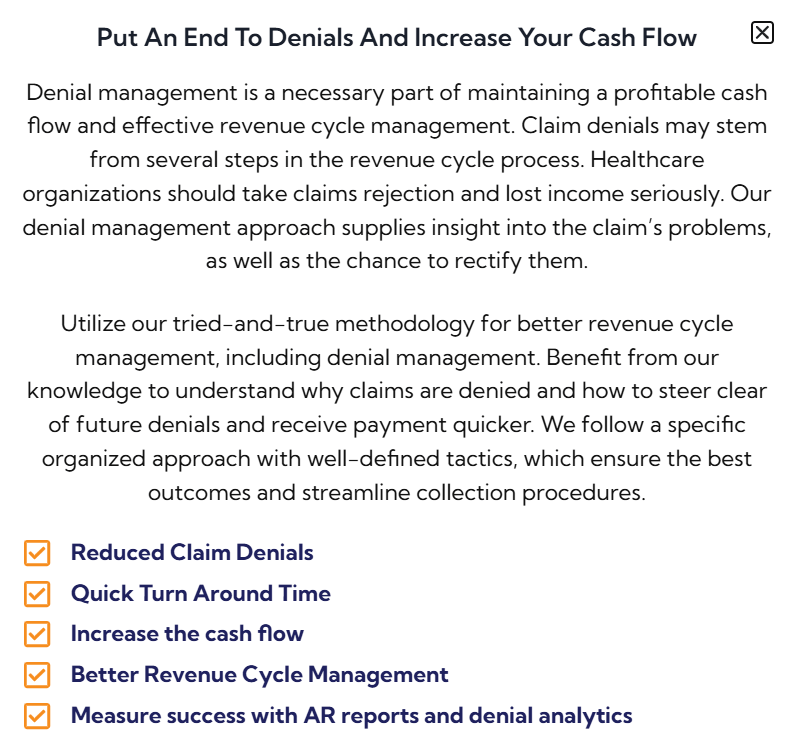
Denial management is crucial to:
- Faster reimbursements
- Better cash flow
- Reduced administrative burden
- Improved patient satisfaction
Denial management in healthcare involves detecting, investigating, resolving, appealing, and avoiding denied insurance claims to maximize revenue and enhance the efficiency of the revenue cycle.
What Is Denial Management in Healthcare?
Denial management is a systematic process of medical claim denial identification, investigation, correction, appeal, and prevention. It is a crucial component of healthcare Revenue Cycle Management (RCM) that ensures that healthcare providers are adequately reimbursed for their services.
Denial management is about reducing revenue loss due to denied claims, increasing claim submission accuracy, and making the processes more efficient.
Denied Claims Vs. Rejected Claims
Although often used interchangeably, denied and rejected claims are different:
- Denied Claims – Claims that have been sent to the Payer and the Payer has denied the claim.
- Rejected Claims – Claims with errors that are returned before the Payer processing.
To minimise leakage in revenues and enhance collection performance, healthcare organisations need to adopt denial prevention strategies. Denial management can be a valuable method for healthcare organizations to minimize revenue loss by understanding the reasons behind claim denials and taking corrective actions to avoid further denials.
Why Denial Management Is Important in Healthcare
There are various reasons why denial management is important in healthcare.
Protects Revenue
Denied claims have an effect on organizational income. Good denial management ensures recovery of unpaid claims and reduces revenue loss.
Improves Cash Flow
Improved claim resolution and reimbursement shortens payment delays and enhances cash flow management.
Reduces Administrative Costs
A proactive denial management process reduces the manual rework, thus decreasing operational costs and employee productivity.
Improves Claim Acceptance Rates
This is because cleaner claims and better claim submission accuracy result in higher first-pass acceptance rates.
Enhances Patient Satisfaction
Proper billing procedures minimize patient complaints and streamline the billing process.
Understanding the Healthcare Claim Denial Process
Claim Submission
Healthcare providers make claims to insurance companies for reimbursement.
Claim Review by Payers
Verification of coverage, eligibility, policy compliance, coding, and medical necessity by insurance companies.
Claim Approval or Denial
Once reviewed, claims are either accepted for payment or rejected with a reason code.
Denial Analysis
Billing teams review the Electronic Remittance Advice (ERA) and Explanation of Benefits (EOB) report to investigate the reason for the denial.
Appeal & Resubmission
Errors are corrected, supporting documentation is collected, and claims are appealed and resubmitted for payment.
Denial Management Workflow
Claim Submission -> Claim Review -> Denial Identification -> Correction -> Appeal -> Reimbursement
Common Reasons for Medical Claim Denials
Claim denials in healthcare can be caused by avoidable administrative or clinical problems.
Incorrect Patient Information
Denials may occur due to inaccurate patient information, insurance, or identification numbers.
Missing Prior Authorization
Treatment is only available after payer approval. Unauthorized claims are often due to missing authorizations.
Coding Errors
Mismatched ICD-10, CPT, and HCPCS codes may result in reimbursement problems.
Duplicate Claims
Multiple claims for the same claim may be denied.
Incomplete Documentation
Often, there is a lack of medical records or clinical documentation, and it results in rejection by the payers.
Eligibility Verification Issues
Claim denials are often caused by the change of coverage or inactive policies.
Timely Filing Errors
Claims that are not submitted before the deadline set by the payers might not be reimbursed.
Non-Covered Services
Certain treatments or procedures may be “out-of-pocket” for the patient’s insurance.
Quick Insight – The majority of healthcare claim denials can be avoided if accurate documentation, proper coding, and efficient billing processes are followed.
Types of Claim Denials in Healthcare
Healthcare claims are denied for various reasons, including:
Soft Denials
Soft denials are temporary and may be fixed and resubmitted for payment.
Hard Denials
Hard denial is a denial that cannot be reprocessed and typically means that revenue is lost.
Clinical Denials
The reasons for these denials are related to medical necessity, treatment appropriateness, and/or clinical documentation.
Administrative Denials
Administrative denials occur due to registration or coding errors, incomplete data, or violations of the payer’s policies.
The Denial Management Process Explained
Identify and Investigate Denials
Revenue cycle teams review ERA and EOB reports to look for denial codes and to find the root cause.
Categorize and Prioritize Denials
Denials should be categorized according to:
- Payer
- Denial category
- Financial impact
- Service type
Correct Claim Errors
Billing teams resolve coding mistakes, missing documentation, and patient information mistakes.
Submit Appeals
The process of collecting and submitting supporting documents when requesting appeals that have inappropriate denials.
Monitor Denial Trends
Patterns of denial need to be examined on a regular basis to find common themes in organisations.
Prevent Future Denials
Long-term denial reduction methods are:
- Staff education
- Workflow optimization
- Technology adoption
- Quality assurance reviews
Key Benefits of Effective Denial Management
- Minimized Revenue Loss – Effective denial management can save healthcare providers from losing reimbursements and prevent the return of denied claims that can hurt the bottom line and financial stability.
- Better Claim Reimbursement – With claim error correction, better coding accuracy, and timely appeals, healthcare organizations can boost claim approval and cash flow with insurance payers.
- Structured Denial Management – A structured denial management process helps the billing team to find the cause of a denial early, resolve it efficiently, and speed up the resubmission of claims, thus decreasing the time needed to receive payout from insurance companies.
- Improved Cash Flow Management – Timely claims are processed, and denial rates will be lower, which will help healthcare providers maintain consistent revenue flow, enhance liquidity, and ensure more streamlined day-to-day financial operations across the organization.
- More accurate claims – Denial management can help limit coding errors, missing documentation, eligibility issues, and more claims are accepted on the first attempt.
- Minimized Administrative Burden – Automated deny tracking, streamlined workflows, and proactive claim management reduce manual rework for billing personnel so that healthcare teams can focus on more value-added operational and patient care activities.
- Optimized Operational Efficiency – Recurring denial patterns can be used to streamline billing processes, boost inter-departmental communication, and increase general efficiency and productivity of the revenue cycle management process.
- Improved Compliance Management – Denial management helps maintain compliance with payer requirements, coding rules, and healthcare regulations, thereby lowering the risk of compliance issues and preventing audits, penalties, and disputes for reimbursement.
- Better outcome – Denied claims are recovered, and future denials are prevented, which directly affects the organization’s profitability, reduces revenue loss to the organization, and enhances the financial status of the medical practice or healthcare facility.
- Improved Patient Billing Accuracy – Ensure accurate claim submissions and proper documentation to minimize patient billing disputes, eliminate errors, and provide a better financial experience for patients receiving healthcare services.
Denial Management vs Rejection Management
| Feature | Denial Management | Rejection Management |
| Claim Status | Processed but unpaid | Rejected before processing |
| Cause | Medical or administrative issues | Technical or submission errors |
| Requires Appeal | Usually yes | Usually corrected and resubmitted |
| Impact on Revenue | High | Moderate |
Gaining insight into this distinction enables healthcare providers to focus resources and speed up their reimbursement recovery efforts.
How Technology Improves Denial Management
These days, many healthcare organizations are turning to automation and cutting-edge analysis to enhance denial management performance.
AI-Based Claim Analysis
AI can detect potential denial issues before claim submission.
Automated Eligibility Verification
Automatic eligibility verification for insurance minimises errors in real time.
Real-Time Denial Tracking
Automated dashboards help you gain instant visibility of denial status and trend.
Predictive Analytics
Predictive solutions offer tip-offs for denial patterns and provide preventive measures.
Revenue Cycle Automation
Automation makes billing more efficient, cuts down on manual tasks and makes claims more accurate.
Healthcare organizations can proactively recognize patterns of denial and enhance the accuracy of claims with automation.
Best Practices to Reduce Claim Denials
The following best practices can help healthcare providers minimize denials:
- Make sure insurance is checked before appointments.
- Provide proper medical coding
- Get any necessary pre-authorizations
- Make clean claims the first time submitted
- Keep an eye on denial trends regularly
- Provide training for billing and coding personnel
- Automated RCM software should be used
- Keep thorough and accurate records
- Perform periodic internal inspections
- Stay updated with the changes in payer policy.
Key Metrics to Track in Denial Management
When managing denial, it is important to monitor certain key metrics:
Denial Rate
Records the proportion of claims that are not covered by payers.
Clean Claim Rate
Records claims when they are accepted, without needing to request corrections.
First Pass Resolution Rate
Measures claims successfully paid on first submission.
Days in Accounts Receivable
Assesses the speed of collection of funds by the organisation
Appeal Success Rate
Records the percentage of Denials overturned.
These metrics enable organizations to constantly improve the performance of their denial management.
Challenges in Healthcare Denial Management
Healthcare providers have several challenges in the denials management process, including:
- Complex payer requirements
- Frequent policy changes
- Staffing shortages
- High administrative workload
- There is a lack of visibility on denial trends
- Manual tracking inefficiencies
Advantages of Automation and Outsourcing
Denial management tools and specialised denial management services can help to boost efficiency while minimising manual work, speeding up appeal processing, and delivering richer denial analytics.
Role of Denial Management in Revenue Cycle Management
Denial management is an integral part of healthcare revenue cycle management that can help with:
- Revenue optimization
- Faster collections
- Reduced AR days
- Improved payer communication
- Enhanced financial reporting
- Better reimbursement outcomes
The companies that have a robust denial management program generally perform better financially and have higher operational efficiency.
How Nirvaana CS Supports Healthcare Denial Management
In Nirvaana CS, we assist healthcare providers in optimising their revenue cycle performance with holistic denial management solutions.
Our services include:
- Leading denial management experts
- Detailed root-cause analysis
- Provide appeal and resubmission support
- Denial trend reporting and analytics
- The optimization of the revenue cycle in the context of the strategies that can be employed
- HIPAA-compliant workflows
Nirvaana CS uniting industry knowledge, cutting-edge technology, and proven revenue cycle best practices to help healthcare organizations safeguard lost revenue and enhance financial results. Nirvaana CS allows healthcare providers to cut denials and recover lost revenue while boosting overall financial performance.
Frequently Asked Questions (FAQ)
What is denial management in healthcare?
Denial management involves the recognition, analysis, correction, appeals, and prevention of denied medical claims in order to maximize the reimbursement and enhance the revenue cycle process.
Why are medical claims denied?
The most frequent reasons for medical claims being denied include coding errors, documentation issues, eligibility issues, missing prior authorizations, duplicate claims, and filing claims in a timely manner.
What is the difference between denial and rejection?
A denied claim is a claim that has been submitted, but the claim is not paid or has failed to be paid, and the claim could not be processed or has errors that need to be corrected before the claim can be submitted.
How can healthcare providers reduce claim denials?
To minimize denials, providers should ensure eligibility verification, proper coding, prior authorizations, documentation, and the use of automation tools.
What are soft and hard denials?
Soft denials can often be corrected and resubmitted; hard denials are permanent and are usually unrecoverable.
How does denial management improve cash flow?
Denial management becomes a key factor that speeds up claim resolution, elevates reimbursement rates, and cuts down claim delays, leading to improved cash flow.
Can automation reduce healthcare claim denials?
Yes. By automating claims, you can reduce the number of errors, eligibility checks, claim denials, and predictive analysis, which help prevent many typical causes of claim denials.
Conclusion
Denied claims can cost healthcare organizations in many ways, including lost revenue, higher administrative costs, and delayed reimbursements. A proactive denial management approach aids providers in getting to the bottom of the denial, recouping unpaid claims, and avoiding future denials.
To ensure optimal financial results, healthcare organizations need to invest in continuously monitoring denials, optimizing processes, and automating manual tasks. Denial management is not just about better reimbursement rates, but also about greater operational efficiency and patient satisfaction.
Denial management enables healthcare organizations to boost reimbursement, minimize revenue leakage, and optimize the revenue cycle with proper management. Collaborate with Nirvaana CS to enhance your denial management approach and maximize revenue recovery.